Showing posts with label benefits of service learning to the community. Show all posts

Friday, April 10, 2020

Teacher Reset-Enjoy the Journey


One of the best boarding school which is established in Dehradun, Ecole Globale said that as you work to rejuvenate your soul through this series and on the far side, one among the foremost necessary takeaways of all is this: the marrow of life is found within the journey, and if you're too centered on what lies ahead, you'll miss the whole purpose. Only too typically we think, "once I accomplish this one huge factor — land the dream gig, make a million bucks, marry a beautiful and sensible and hilarious animal lover — I'll finally be happy." and that we resign ourselves to being sad till we accomplish the same thing.
And here's the thing: to succeed in your most authentic and fullest potential, you've got to line goals. You've got to strive. And you've got to keep a constant pulse on your focus; therefore, you make sure you're setting your course within the direction of your goals and dreams. But honestly? It's 100 percent what happens in the way that matters most. The small moments that make up every hour. The hours that make up a day. The times that structure a week…these bits and pieces (like a patchwork quilt) make up your whole life. And who you're in these moments — and without delay — defines you more than your achievements.

Remember, after you broke down your goals into small goals? Small achievable bits that will cause you to feel good, build confidence, and encourage you to stay working toward your larger goal? Well, currently, I would like you to reflect back on some of those.

Did you get fro-yo with a friend? Did you opt for a jog? Did you spend quality one-on-one time along with your grandfather Fred? Whatever micro goal you set and accomplished, merely remember on however it felt. If the goals you set were small enough, they consisted of conversations. Exchanges. Experiences. Moments. They consisted of being present.

And whereas no conversation, or exchange, or experience, or moment is while not a flaw, simply being in them may be a beautiful factor. By taking your brain off crossing some distant line, you mechanically shifted your attention to the here and now. The mission is accomplished.

No matter how good your cause or how outstanding your achievements, after you set your sights on the remote future, your day-after-day will feel unmeaning and hollow and also the worst half is that by creating your happy moments for each day that will or might not come back, you're completely setting yourself up for disappointment. Seriously. If you win that one lofty goal — then what? And if you don't achieve the goal? You'll desire a failure, and you'll have passed over on every bit of incredible that has formed you, forged your character, and built your life while you were specializing in the prize.

Life is very short to miss out on the little moments, the in-betweens, the present. Provide yourself permission to like yourself without delay. It's time to get pleasure from the journey.

This article Is contributed By Ecole Globale International School

Tuesday, April 7, 2020

Harnessing the Influence of Social Media in the Classroom


What if rather than ignoring the huge, white, social media elephant within the room, you embraced it? As academics, it's necessary to organize students not just for the world they board but conjointly for the world that's ahead. And the influence of social media is probably going here to stay, why not use it to your advantage? 
Here are some ways that to embrace social media as a teacher and leverage its charms in your schoolroom. 

Create virtual penpals

Remember penpals? There was nothing better than checking the mailbox after school and finding a letter!
It's time to bring back the thrill, 2020 style. nowadays best girls boarding schools in IndiaEcole Globale Dehradun is also taking care of their students and making their education more digital so that students can understand and take more interest in their studies while studying in the home as you all know its 2020 style of education is changes now teachers send assignments through mail and students after completing their assignments submit they are through the mail.
Get connected with a fellow teacher in your district or even another state or country. Students will use a class-created handle to tweet different students via Twitter. Along you'll be able to Facebook Live or Skype different school rooms in reality. Prerecord Youtube videos or chat on-line to share experiences and fun lessons. 
Your students can have a blast about to know different students and learning more regarding youngsters like them.

Share the success

Social media could be a fantastic way to post events and share student successes on-line. By making class groups on social platforms like Facebook, Instagram, or Snapchat, you and your students will share your best recollections.
Share photos and comments regarding your field trip. Create a student of the month with a brief bio post and favorite photos: share student work and project examples. Post your Pinterest-worthy bulletin boards. 
And with privacy settings, unidirectional communication is possible. A schoolroom or school account is often accustomed to sharing content while not receiving comments from outsiders. Students will realize the freedom to share their schoolroom life with others without the fear of on-line strife. 

See what they really understand

Make use of these quick student texting thumbs by incorporating social media into student exit tickets, summaries, and school assignment assignments. 
Social media platforms are created for short responses, perfect for those students who could also be overwhelmed by long responses or essays. And quick summaries facilitate to coach them to focus on the most idea and be concise in the words they opt for.
In the kind of an exit ticket, conclude the class by asking students to post responses or answer questions on the day's lesson. Evaluate what students have learned quickly and simply. 
Create a brick-by-brick discussion board. Assign students to post a thought, insight, or question they'll have regarding the content of your class. Then each student within the class should post a constructive comment to a different friend. Students can have the chance to help each other, whereas encouraging a schoolroom community and reflecting on their learning. 

Forget the walls of the schoolroom

Social media permits students to find out beyond the classroom; however, it can even be a valuable tool for academics to deliver data. 
Facebook Live is an amazing feature that enables academics to record videos for students to look at through live-streaming or by accessing the recorded video later. 
Create videos to review subject material or to reinforce a tough lesson. Or find video resources specifically created for academic purposes at YouTubeEdu. Be that crazy teacher while not the mess that comes with it by viewing large-scale experiments via video. Learn songs distinguishing similes from metaphors. Watch the authors discuss their work or view the animal kingdom. 
TED-Ed talks are specially designed for the schoolroom. These award-winning videos will spark your student learning, and many provide accompanying teacher lessons. 

Explore writing for the students

Students use social media platforms or templates to explore writing. Whether for artistic or purposeful writing, social media are often an excellent way to get youngsters into the active craft. 
Get your students writing poetry. Haiku writing is commonly a popular sort of poetry for students, and you'll be able to build it more interactive and challenging by having students tweet their Haikus. 
Create spoken poetry on Twitter or Instagram. Create hashtag line poems with trending subjects. 
Use social media as story starters or writing topics. Students will conduct analysis more regarding the subject or the author of the post while developing their writing skills. 
Learn more regarding descriptive linguistics by editing social media content. Celebrities aren't always the simplest writers, and posts will usually be full of grammar and spelling mistakes. Explore word decisions by encouraging revision with orthography or vocabulary words. Use tweets and posts to stress grammar lessons or as warm-up activities.

Friday, April 3, 2020

Interactive Learning for Student Engagement and Success


New and effective teaching methods are something today's educators are perpetually on the lookout for. Finding methods that also meet the Common Core requirements as well as keep students engaged is particularly troublesome to discover. However, several of the foremost successful teachers out there have found the simplest way to do both with profound success.
These education professionals are using interactive learning methods to have interacted with their students. They're taking real-world problems, bringing them into the classroom, and permitting students to dig into them and develop their own solutions.

Going Outdoors

Using the great outdoors to show a lesson may be a brilliant way to both involve students and make a way of wonder for the outside world. Varied studies suggest that early academic experiences outdoors play a big role in instilling environmental awareness in students that they'll carry into adulthood. Furthermore, learning outdoors has been shown to boost student attendance, test scores, and attitude toward learning new things.
In order to meet outside education needs, most school rooms partner with an area organization that enables the school which is located in DehradunEcole Globale is to utilize the land during class time. Depending on the location, consultants could also be provided to teach some lessons.

Getting Technical

Interactive learning has brought an entirely new set of skills and ambitions to scholars — a strong mapping technology software with applications in almost any field of study . each semester, the students in the class opt for a professional mentor that they'll then facilitate by completing a study for them. The student project to vary from working with city planners to map stormwater drainage systems to working alongside the Department of Fish and wildlife to map wetlands in the given area.
These projects don't seem to be solely fully interactive and interesting to students, but they're teaching them real-world skills that can be applied directly to a career after, or before, graduation. Scholars are able to develop professional relationships and complete something that makes a distinction in their community. Several of the students are pleased with the topics they learned within the class; in the end, they chose what they did base upon their interests, not as a result of they were told what to focus on. Some even continue their mapping software education after the class is complete. there are reputed best girls boarding schools in India click here who provide technical education for their campus students so that they should know about technical things and understand studies easily. 

SIM-ulation

A new interactive learning technique stems from the use of computer games to teach students concerning abstract ideas in a game-based approach. Academic games are available every form and can be designed to hide nearly any topic that an instructor is interested in covering. They need to be shown to keep students concerned through their fun and competitive nature. Computer games have additionally helped educators identify wherever students are troubled the most. These topics will then be covered a lot of thoroughly within the lecture-room.
One example is Sim city, a game wherever users simulate managing each side of a city. Academics will set limits or goals for college kids to get in a set amount of your time, such as raising the population or implementing specific policies, whereas keeping everything else in working order. For students, it provides a chance to know the interconnectivity of the resources around them. As an example, how growing industries impact environmental quality.

Growth Mindset-Tips for Motivating a Struggling Student


Lacking motivation, trouble staying focussed, problem taking direction, and general withdrawal – all lecturers can recognize the signs of a troubled student.
Seeing a student encounter difficulty is upsetting, particularly if you've got an outsized class size and feel like unable to spend the necessary time with them. However, there are many growth mindset activities you'll integrate into your classroom and a few ways in which during which you'll utilize this way of thinking yourself as a teacher, to provide some much-needed support and motivation.
As we all know that students face problems while they were studying and feel hesitant to ask their problems from teachers that's why most famous girls school in DehradunEcole Gloable has started some new tips for the struggling students and motivate them for their better growth
"Growth Mindset" may be a theory pioneered by Carol S. Dweck, Ph.D., and it outlines that every one brain is "trained" or developed over time.

Science has shown that the mind is malleable, and may be altered and developed with the correct exercises. A growth mindset rejects the notion that talent and capability are innate, and supports instead that with the proper discipline, any skill can be learned.

When observing a struggling student then, a tutor with a "fixed" mental attitude might even see a kid that's naturally talented in different areas; however, they can ne'er act in the space during which they're experiencing the problem. For a tutor with a mental growth attitude, this can be not the case – all that's required is a few developments and need to apply in this area, to grow and expand the part of the mind that deals with learning new ideas, and reaction to praise and failure.

Using Growth mental attitude to inspire Students
If you wish to tackle troubled student using the latter choice, there are some straightforward ways in which you'll do that may be useful once applied one on one, similarly on the entire class:

Introduce mental growth attitude
Making your students tuned in to the concept can help boost their confidence. You'll show the class a growth mental attitude video, or teach them concerning how the mind works with games or pictures, and show them that it's attainable for their brain to develop – and thus, a struggle now could be a step towards success later.

Change how you handle mistakes
For many students, obtaining something wrong or "failing" is a source of enormous frustration and embarrassment. As such, they will retreat from trying again, which may mean they move additional far from getting to grips with the concept at hand. Teach your all students that "failing" or creating a mistake may be a sensitive issue because it takes them a step closer to getting it right. You may do this by having the word form "FAIL – 1st Attempts In Learning" visible in your room at all times and relating this each time they encounter an obstacle.

Administer positive praise
Even if a kid isn't grasping the concept or obtaining things right, reward them for working hard and making an attempt to do so. This may encourage them to stick at it and facilitate them to feel less self-conscious about trial and error.

Show students samples of past failures
Best girls boarding schools in India also show some other school failures students result.It will typically be that a mental block hinders students from putting forth their best effort, and it will often be that this can be because of fear of embarrassment or failing. To get rid of this, show students examples of "famous failures" like Edison or Einstein. By showing them that even a number of the brightest minds struggled, you'll show them the importance of perseverance and asking for help.

Help students find worth in learning
If students feel they need to do the work or have to do well, they will not be as inclined to do exhausting. By building the worth in mastering the topic or topic, and tapping into the requirements and aspirations of the individual student, you'll create the topic something they require to learn.

Wednesday, April 1, 2020

Best Strategies for Calming a Child's Nighttime Fears

Post image
Every night, children across the world worry that there's a monster hiding below the bed. It's a standard fear that the majority of adults will relate to—the fear of monsters isn't new. It's a fear that pre-dates video games and social media and has persisted throughout the generations.
If you have a toddler who is convinced that when the lights go out, there's a furry monster who is going to crawl out from under the bed and 'get him,' you're not alone. But, it may be powerful to know how to calm your child's anxiety and convince him that he will sleep in his bed alone without being attacked by a monster that lives under the bed. boarding Schools in India regularly provide tips to students, like washing the feet before going to bed, doing meditation and others, these kinds of tips help the student to have stressless sleep.
The fear of Monsters
The fear of darkness, particularly of being left alone in the dark, is one of the biggest fears children experience.
A 2015 study published within the International Journal of psychophysiology suggests that the fear isn't necessarily of the dark, however, it is more of a fear of nighttime.
Some researchers suspect this is often evolutionary. Nighttime is once people are also most vulnerable to predators. Kids might have learned to cry as a way to urge adult attention and keep safer from nighttime danger.
So it's probable that your child's fear of nighttime and darkness is hardwired and the anxiety she naturally experiences at bedtime is probably going to fuel her imagination—which may be why she's convinced that the second you leave her alone, a monster is hiding below the bed.
It's probably that popular culture plays a role in fostering kids' imaginations about monsters. There are continually books, movies, and cartoons about strange looking creatures.
So as frustrating because it can be to have to return your kid to bed half a dozen times as a result of she insists there's a monster below the bed, it may be useful to achieve an improved understanding of age-appropriate fears so you'll be able to decide best how to intervene.

Post image
Age-appropriate Fears
According to Ecole Globale childhood fears usually, aren't rational. But that doesn't mean those fears aren't real. Here's what to expect from your kid through the ages:
Toddlers – kids between two and three are also afraid of anything they don't understand. Whenever they see something that doesn't appear quite right—like granny wearing a bandage or a plate with a crack in it—they might begin to cry.
Preschoolers – between the ages of three and five, kids tend to worry about imaginary dangers, just like the worry that a monster lives below the bed. They need trouble separating reality from fantasy and that they have vivid imaginations that fuel their fear.
School-aged kids – Fears usually become more reality-based throughout the school years. A toddler is also fearful of thunderstorms, barking dogs, or fires. They will conjointly worry about their parents' health and their safety and that they should still experience some sleepover anxiety. As their understanding of the globe grows, irrational fears concerning monsters living below the bed should slowly begin to disappear.
What to Avoid
These parenting strategies might backfire within the end and cause your child's fears to become worse:
Teasing your kid. Creating fun of your child's fears or embarrassing her might fail. Several adult fears and phobias aren't essentially based on reality either—like the fear of flying in an airplane or the fear of public speaking. So honor your child's feelings by treating her with respect.
Arguing your logic
Don't waste your energy attempting to convince your kid that monsters below the bed are illogical—especially if you've got a toddler or preschooler. Your logic won't work.
Minimizing your child's feelings
Saying, "Quit being such a sissy," or "It's not a big deal," is harmful. Instead, acknowledge that your child's fear could be a big deal to her and that you understand what it's like to feel afraid.
Scaring your kid
Kids need to face their fears step by step. Don't do something forceful to assist your kid in overcoming her fears. Locking her in her room once she's panic-struck or allowing her to watch scary movies can reinforce her fears.
When to seek professional help
In most cases, the fear of monsters under the bed slowly goes away as a toddler matures. That doesn't mean the fear of the dark can go away completely, however. It's traditional for older children to be still a bit cautious of the night.
If your child's fears appear to interfere together with his everyday life, you'll need to think about professional help.
If he's having trouble sleeping as a result of he's scared, it should affect his behavior the next day. Or, if his fears of monsters are thus massive that he usually talks concerning them throughout the day or all of his play revolves around monsters below the bed, discuss with your pediatrician.
The pediatrician might offer some ways that may improve your child's sleep, reduce his fear, or address bedtime behavior issues. If the pediatrician thinks your child may have anxiety or a phobic disorder, your kid may be referred to a mental health professional.
Talk medical help might teach your kid skills to reduce anxiety. You'll be invited to be involved in your child's treatment; thus, you can support your child's efforts and assist in lowering her fears.
This article is contributed by Ecole Globale International School

Monday, March 30, 2020

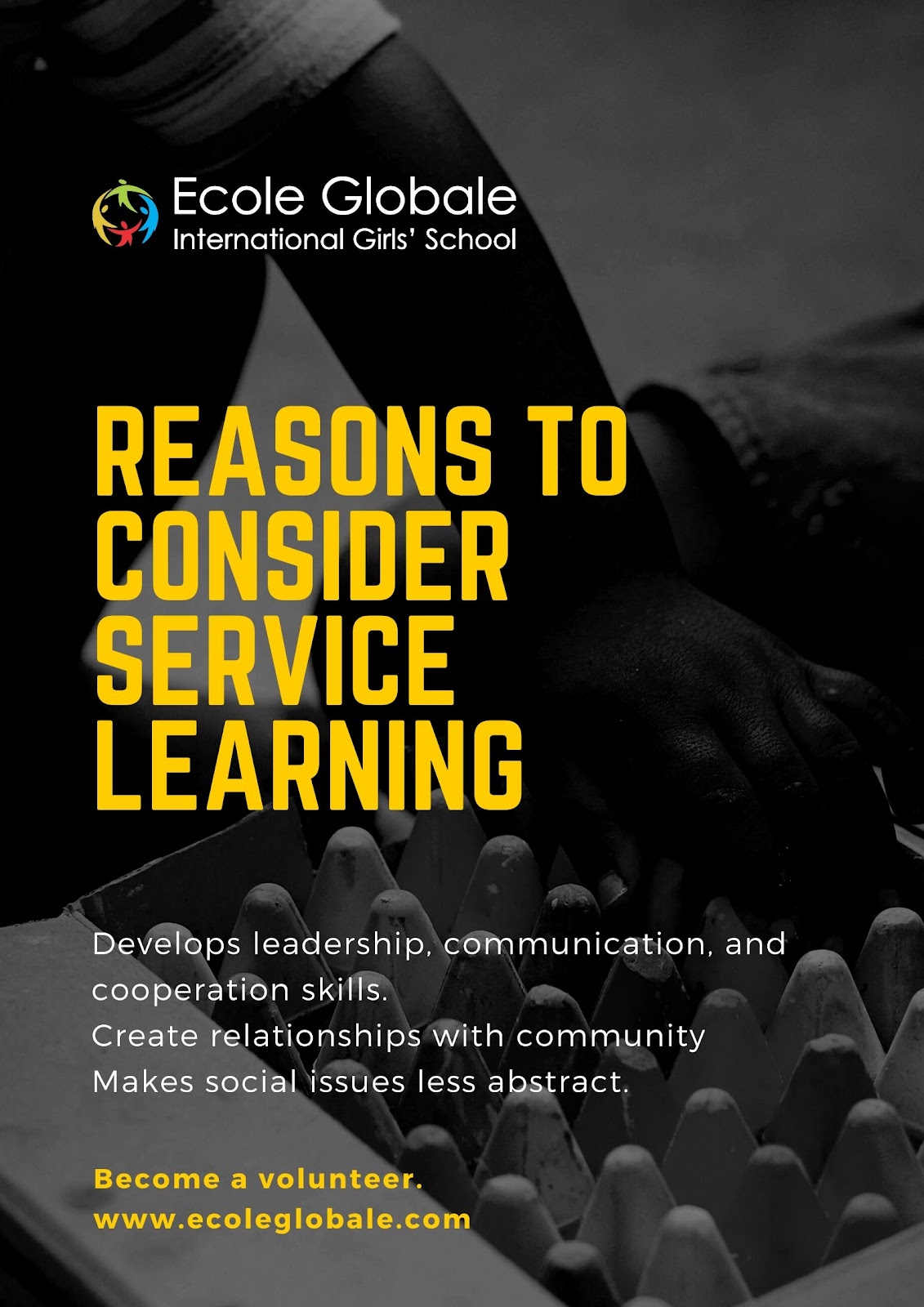
5 Reasons to Consider a Service Learning Project

Reasons to Consider a Service Learning Project

If you're a tutor, you will have heard the term "service-learning" and concluded that it's a community service project that is taken on by a group of scholars, and spearheaded by a teacher. The teachers of the best boarding school in Dehradun know what service Learning is. Like Ecole Globale, a girls' boarding school, makes its students confident enough by developing leadership skills in them.

You'd be partially correct. Whereas service learning is so grounded in activities that are supposed to boost a community, the 'learning' part plays a key role too. The service Learning defines it as "a teaching and learning strategy which integrates meaningful community service with specific instruction and reflection to enrich the educational experience, teach responsibility, and strengthen communities."

These five concepts illustrate some of the benefits of service-learning :

Students develop leadership, communication, and cooperation skills.
From the start of a project, students apply important skills that are able to benefit them as they transition to educational activity and also the world of work. As a result of a service-learning project that includes multiple components, students should learn to collaborate and discuss their concepts, which helps improve their ability to figure as a team and communicate. And whenever students get the chance to require a charge of something important, they rise to the challenge. Ideally, a service-learning project is student-driven. Although younger students might have support and guidance, they will still establish challenges they see in their community and start talking concerning possible solutions. Older students can have a wider worldview and should end up with a range of issues they hope to tackle. No matter age, students can begin building a set of relevant, useful skills.

It is a window to career exploration.

Depending on the specification of the project, engaging students in commission learning will offer insights into careers. For example, children who collect canned goods as a part of a food drive, then learn about nutrition and organize the products into healthy meals, are learning very basic concepts about what dieticians and nutritionists do. This might spark an interest in some students, that they may still investigate as a part of alternative projects and through personal analysis. As a result of there's a stress on making an educational affiliation; students are able to see correctly; however, their classroom learning will have wider applications.

It makes social issues less abstract.

If you ask a kid of almost any age to share the challenges plaguing their community or the world at large, they'll in all probability be able to rattle off many. Homelessness, drug abuse, unhealthy food, and financial condition are a number of the issues students could observe within their community and see in the media. However, there's often a buffer between these observations and reality. Whereas there are students who tolerate these difficulties, the rest might not understand the impact on their community or their classmates. Helping your students establish a specific challenge to handle will facilitate to create awareness and should cause a lifelong commitment to service.

Students get the opportunity to create relationships in their community.

Service-learning needs students to get out of the schoolroom and helps them meet local leaders. Networking is usually unmarked as an ability that has to be educated, particularly to younger students. However, having students meet influential people from government and community organizations could be an excellent way to create relationships. A service-learning primarily based setting may be a good icebreaker and provide common ground for communication between youngsters and adults. As children enter high school and college and want to perform extra community service, they'll have contacts from their service-learning projects who are also able to facilitate. Learning to the network could be a very important ability for career success, and a service-learning project will facilitate students to begin to hone these skills.

The community and cause benefit from the students' efforts.

In step with the middle for Community-Engaged Learning at the University of Minnesota, there are multiple benefits to connecting students and services. Engaging students could be a great way to increase public awareness of an organization's purpose and challenges. Food pantries typically receive an abundance of donations around the holidays; however, notice that they struggle to satisfy needs throughout the rest of the year. If students developed a service-learning project around supporting a local food bank, they might run a food drive, whereas act the requirement for year-round donations, allowing them to find out about nonprofit marketing.

If you'd wish to engage your class with a service-learning project, begin by considering the requirements of the school itself. A good initial project can be found right outside your schoolroom door, and doing one thing to strengthen the school community can have a powerful impact and should inspire more interest in service-learning. Once children are familiar with designing and implementing a project, they will apply their data to something more extensive.

This article is contributed by Ecole Globale International School.